The Best Niacinamide Serum in India: A Complete 2026 Guide
August 19, 2026
Face Wash for Men: The Complete Guide to Cleaner, Healthier Skin
September 9, 2026

Most skincare talk is noise. Buzzwords stacked on buzzwords. But every once in a while something shows up that actually changes how you think about your own face. This is one of those things.
Your skin is not a covering. It is always communicating with your brain, and your brain is always responding. Stress appears as a rash. A stressed skin condition can then affect your mood. It keeps going in circles. So what happens when skincare companies start creating products for that connection of not paying attention to it? That is the point of this group. It is a bigger change than it seems.
What Is Neurocosmetics?
So what is it exactly? This field sits between dermatology, neuroscience and old-fashioned cosmetic chemistry. It’s not chasing collagen count or dark spots. It’s asking a question: what happens at your skin’s nerve endings, and how does that ripple back out into how you actually feel?
Turns out, quite a lot. A recent narrative review that synthesised 159 studies on this exact topic mapped out the whole chain, step by step:
- Your brain and pituitary release corticotropin-releasing hormone (CRH) and adrenocorticotropic hormone (ACTH).
- Your adrenal glands respond by releasing cortisol, catecholamines, and androgens.
- Nerve endings in your skin release their own signalling peptides, mainly substance P and calcitonin gene-related peptide (CGRP).
None of that runs one direction only. Skin-derived inflammatory signals, cytokines, chemokines, and neurotrophins can travel back and cross into the brain’s own signalling environment, feeding the same loop from the other side. The researchers behind that review called it a genuinely bidirectional axis. Not a one-way street.
If you deal with stress flare-ups, this cuts both ways. Chronic stress has been tied to impaired wound healing, increased skin fragility, and flare-ups in conditions like psoriasis. Calm skin, on the other hand, seems to send calming signals back up the chain. Dermatologists have a name for this whole overlap: psychodermatology, and it existed as a recognised field long before any brand tried to bottle it.
How Do Neurocosmetics Work?
Skin contains sensory nerve endings. When these endings sense heat, pressure or irritation, they release chemical signals such as substance P and gene‑related peptide. Products in this group are made to block or imitate those signals exactly. Some ingredients mimic the body’s neuromediators. This reduces the stress reaction before it becomes redness. Other ingredients act like a dimmer switch, calming nerve endings so that skin does not send sharp signals to the brain at all.
I find copaiba oleoresin useful. The active compound in copaiba oleoresin binds directly to skin cannabinoid receptors. This mechanism is supported by research. Try coriander seed oil, which a clinical study linked to calmer, less reactive skin. It’s not hydration doing the work here. It’s nerve signalling. And because of that, results can show up fast. Sometimes within minutes, not weeks. That’s genuinely rare in skincare, where most actives need six to twelve weeks before you notice anything at all.
There is also a side worth knowing. Skin does not only receive signals; it sends them out the same cytokines and neurotrophins mentioned earlier. So calming the skin is not a surface fix. It is closing a circuit.
Benefits of Neurocosmetics Products by Cockylife
These products act on the nervous system as well as the skin barrier; you get two kinds of payoff at once. That’s rare.
On the skin side, here’s what actually shows up:
- Calmer, less reactive complexions
- Reduced redness
- Fewer stress-triggered breakouts
On the mood side, it gets more interesting:
- Real improvements in perceived stress in ingredient-level studies
- Better sleep quality with consistent use
It is not a miracle. It is cumulative relief. When skin and mind are treated as connected, then separate routines become more personal. People who have stress flare-ups reach for nerve-calming products. People who want skin stick with the actives. No one is wrong. That flexibility is probably why interest in this keeps climbing.
It’s also why this category resists the usual before-and-after photo test. A lot of what changes is how your skin feels day to day, not just how it photographs. That’s harder to sell. But it’s arguably more honest.
Key Neurocosmetic Ingredients
A short list of ingredients keeps showing up in this space, over and over. So let’s actually look at what’s behind each one, evidence included, not just the claim on the label:
| Ingredient | Used for |
| Copaiba oleoresin | The active compound binds directly to skin cannabinoid receptors, backed by independent research. |
| Frankincense extract | Leans more on tradition than solid clinical proof |
| Coriander seed oil | A real clinical study links it to calmer skin, but that study used oral supplementation, not a topical product. |
| Timut pepper extract | Real clinical trials exist, more than most trendy ingredients get, but again, as an oral supplement, not a face product |
| GABA | Mostly manufacturer claims; independent topical research is thin. |
| Adenosine | Long-established, well-documented skincare ingredient |
Worth sitting with that table for a second. A few of these ingredients have real science behind the effect itself, just not behind the specific way they’re being sold to you, on your skin, in a jar.
Smaller independent labels have noticed the shift toward this kind of transparency too. Cocky Life, for instance, has folded some of these calming actives into its own formulations, leaning on the same research base laid out above rather than inventing new claims.
Popular Neurocosmetic Products of Cocky Life
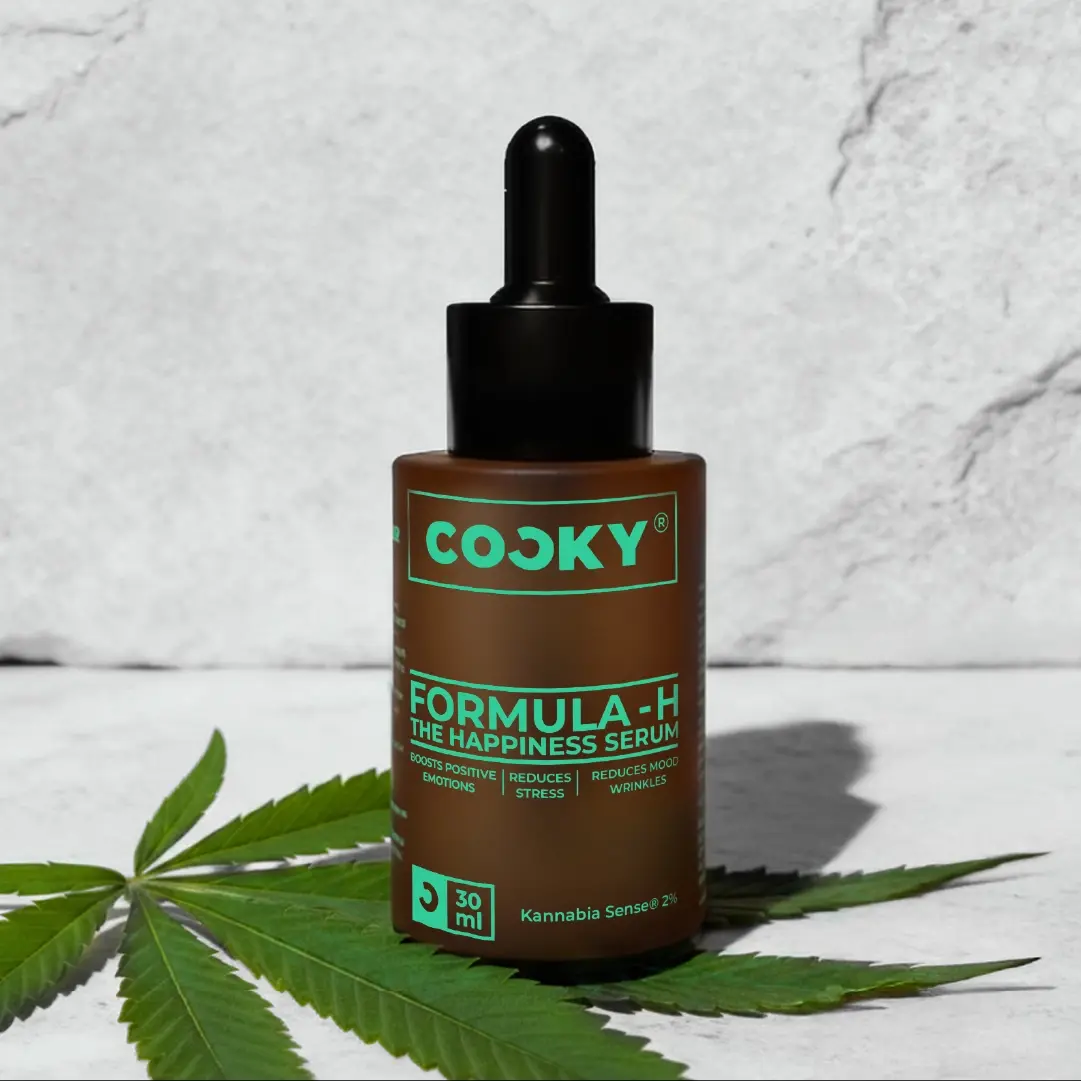
Formula H, The Happiness Serum
Ingredient: Kannabia Sense, a cosmetic active made from Cannabis sativa callus culture technology. Created for use on the skin with no psychoactive effect.
Benefits:
- Helps with skin comfort, moisture and an awake look
- Takes on stress-related skin tiredness and lack of shine caused by city life and outside conditions
- Acts as a stress relief serum: makes dullness less visible, makes skin feel better, and gives a more even, fresh appearance
- Acts as a mood-boosting serum skin that feels good and looks good and can improve self-esteem
- Lightweight feel absorbs fast and works well with other products
- Good, for all skin types: oily, dry and mixed
- Made for everyday use, it gives the best results when used regularly
Are Neurocosmetics Safe?
Yes. It depends on what you mean by safe. A few practical things worth knowing:
- Most active ingredients here come from plant extracts, peptides, or compounds already used in ordinary skincare and are regulated the same way any other cosmetic ingredient is, not as a drug.
- Natural doesn’t mean risk-free. Coriander-derived ingredients and pepper extracts can trigger reactions in people with existing plant or fragrance sensitivities. Patch test first. Always.
- Most of the mood and stress claims in this category come from smaller, ingredient-level studies, not large clinical trials on finished products.
That last point matters more than it sounds. Results vary person to person. No serum replaces real treatment if you’re dealing with diagnosed anxiety, depression or a condition, like psoriasis. Use it alongside care. Not instead of it.
FAQs
Neurocosmetics is a mix of science and marketing, honestly. The main idea that stress and skin talk to each other through hormones and nerve signals comes from research that has been reviewed many times. Some ingredients that support that idea, such as coriander seed oil and timut pepper extract, only have evidence for use, not for a serum or on skin. So neurocosmetics science is real. Whether neurocosmetics are applied correctly is a question.
Yes, faster than skincare. These formulas target nerve signalling, and users feel an effect in just a few minutes. Conventional actives usually need six to twelve weeks before users see any change. However, the speed of feeling is not the same as lasting results, so do not judge the routine on day one.
Neurocosmetic skincare is safe for people. Not for everyone. Most ingredients are plant extracts or peptides that are already used elsewhere in skincare. They are regulated the same way as any other cosmetic. Natural does not mean risk-free. Ingredients derived from coriander or pepper can trigger reactions in people who already have plant or fragrance allergies. So, a patch test is always recommended.